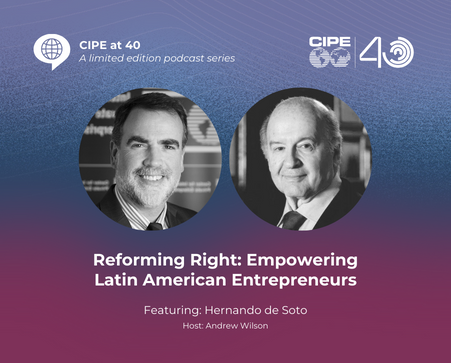
• Hernando de Soto is President of the Instituto Libertad y Democracia (ILD), headquartered in Lima, Peru. Together with his ILD colleagues, de Soto is currently focused on designing and implementing capital formation programs to empower the poor in Africa, Asia, Latin America, the Middle East, and former Soviet countries. De Soto has written two influential books about economic and political development: The Other Path and The Mystery of Capital: Why Capitalism Triumphs in the West and Fails Everywhere Else, both of which became international bestsellers and are available in more than 20 languages.

    He has served as an economist for the General Agreement on Tariffs and Trade (GATT), as President of the Executive Committee of the Copper Exporting Countries Organization (CIPEC), as CEO of Universal Engineering Corporation (Continental Europe’s largest consulting engineering firm), as a principal of the Swiss Bank Corporation Consultant Group, and as a governor of Peru’s Central Reserve Bank. The ILD is considered by The Economist as one of the two most important think tanks in the world. Time magazine chose de Soto as one of the five leading Latin American innovators of the century in its special May 1999 issue “Leaders for the New Millennium,” and included him among the 100 most influential people in the world in 2004.

AddThis Social Bookmark Button
About this Website

Materials presented on this website are based on the conference held in Washington D.C. celebrating the 25th anniversary of the Center for International Private Enterprise (CIPE). The conference brought together leading practitioners, thinkers, and policymakers to build a greater understanding of the meaning of democracy beyond elections as well as the meaning of economic growth that is both inclusive and sustainable. CIPE strengthens democracy around the globe through private enterprise and market-oriented reform. CIPE is one of the four core institutes of the National Endowment for Democracy. For 25 years, CIPE has worked with business leaders, policymakers, and journalists to build the civic institutions vital to a democratic society. CIPE's key program areas include anti-corruption, advocacy, business associations, corporate governance, democratic governance, access to information, the informal sector and property rights, and women and youth. CIPE programs are supported by the National Endowment for Democracy, the U.S. Agency for International Development, the U.S. Embassy in Iraq Office for Private Sector Development, and the Middle East Partnership Initiative.